
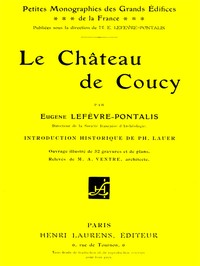
Le château de Coucy by Eugène Amédée Lefèvre-Pontalis
Let's be clear from the start: this isn't a novel. Le Château de Coucy is a deep, loving study of one of the most impressive castles ever built in France. Eugène Amédée Lefèvre-Pontalis, writing in the late 19th and early 20th centuries, was an architect and historian obsessed with medieval buildings. This book is his life's work focused on a single, spectacular subject.
The Story
There's no fictional plot, but the real-life story is gripping enough. Lefèvre-Pontalis walks us through everything. He starts with the geography—why build here? Then, stone by stone, he reconstructs the castle's design: the colossal donjon (keep), the clever defensive walls, the grand halls for living. He introduces us to the powerful Coucy lords, especially the famous Enguerrand VII, who turned the castle into a center of courtly culture and military might. The narrative follows the castle's journey from a fortress of independent nobles through its integration into the French kingdom, its decline, and its sad new life as a stone quarry. The book ends with a poignant look at its state in Lefèvre-Pontalis's own time, standing as a majestic ruin—a fate he could never have known would be so tragically finalized.
Why You Should Read It
You read this for the passion. Lefèvre-Pontalis isn't a detached academic; he's a guide who is genuinely excited to show you around. His descriptions make you feel the scale of the place. When he explains how a portcullis worked or how light fell into the chapel, you can see it. The book turns architecture into a language for understanding power, pride, and artistry. What got me was the underlying sadness. He documented this monument with such care precisely because he saw it fading away. Reading it now, with the knowledge that the German army deliberately destroyed the ruins in 1917, adds a heartbreaking layer. You're holding a preserved memory of something that's gone.
Final Verdict
This is a specialist book, but don't let that scare you off. It's perfect for anyone who has ever wandered through a castle ruin and wanted to know not just what happened there, but how it worked and why it looked the way it did. It's for travelers to France with a deep curiosity, for fans of medieval history who want to move beyond kings and battles to the stones they lived in, and for anyone who appreciates a work written with utter devotion to its subject. It's a detailed blueprint of a lost world.
This text is dedicated to the public domain. You can copy, modify, and distribute it freely.
John Miller
2 years agoFrom a researcher's perspective, the insights into future trends are particularly thought-provoking. I'll be recommending this to my students and colleagues alike.
Sarah Thomas
7 months agoThis was exactly the kind of deep dive I was searching for, the step-by-step breakdown of the methodology is extremely helpful for students. A trustworthy resource that I'll keep in my digital library.
James Harris
10 months agoI've gone through the entire material twice now, and the level of detail in the second half of the book is truly impressive. Truly a masterpiece of digital educational material.
Donald Gonzalez
4 months agoVery satisfied with the depth of this material.


Margaret Thompson
2 months agoAfter spending a few days with this digital edition, the breakdown of complex theories into digestible segments is masterfully done. The price-to-value ratio here is simply unbeatable.