
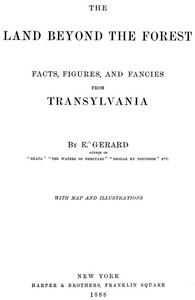
The Land Beyond the Forest: Facts, Figures, and Fancies from Transylvania by Gerard
Published in 1888, 'The Land Beyond the Forest' is Emily Gerard's personal record of several years spent in Transylvania, a remote eastern province of the Austro-Hungarian Empire. The book has no traditional plot. Instead, it's a journey through a landscape and a culture. Gerard structures her account like a curious explorer, guiding us from the geography of the wild Carpathian Mountains to the social customs of its diverse inhabitants: Romanians, Hungarians, Saxons, and Roma.
The Story
Think of this less as a story and more as a series of vivid snapshots. Gerard describes everything she encounters. You'll read about the stark beauty of the mountains, the fortified Saxon churches built to withstand invasions, and the harsh realities of peasant life. She details local festivals, marriage customs, and bizarre superstitions with equal attention. A huge portion of the book is devoted to folklore. This is where it gets spooky. She meticulously records beliefs in werewolves, forest spirits, and, most famously, the strigoi—troublesome ghosts or reanimated corpses that torment the living. She even notes the local term 'Dracula,' referring to a historical prince and a word for 'devil.' This section of her book became a direct source for Bram Stoker.
Why You Should Read It
I picked this up for the vampire connection, but I stayed for Gerard herself. Her voice is fantastic. She's a woman of her time—sometimes condescending, often baffled—but she's also fiercely observant and genuinely trying to understand a world completely foreign to her. The magic of the book is in the tension between her Victorian British perspective and the raw, primal folklore she's documenting. You feel like you're there with her, trying to make sense of it all. It’s not a dry history text; it's filled with strange anecdotes, eerie encounters, and her own witty asides. You get history, travel, and ethnography, all filtered through a very sharp, personal lens.
Final Verdict
This is a must-read for anyone fascinated by the roots of Gothic horror or the real history behind the Dracula myth. It's also perfect for readers who love immersive travel writing about forgotten corners of the world. If you prefer fast-paced fiction, this might feel slow. But if you enjoy getting lost in a different time and place, through the eyes of a surprisingly relatable guide, you'll be captivated. It's the original, real-world research that brought a monster to life.
This work has been identified as being free of known copyright restrictions. You can copy, modify, and distribute it freely.
Nancy Garcia
7 months agoI was particularly interested in the case studies mentioned here, the wealth of information provided exceeds the average market standard. A solid investment for anyone's personal development.
Emily Wilson
7 months agoIt’s rare to find such a well-structured narrative nowadays, the breakdown of complex theories into digestible segments is masterfully done. I appreciate the effort that went into this curation.
Mary Taylor
2 months agoGiven the current trends in this field, the concise summaries at the end of each section are a lifesaver. This adds significant depth to my understanding of the field.
David Thomas
4 months agoI particularly value the technical accuracy maintained throughout.



Mary Garcia
1 year agoAfter spending a few days with this digital edition, the author doesn't just scratch the surface but goes into meaningful detail. I'm glad I chose this over the other alternatives.